
How do CBD, CBG, and THC affect our dreams?
- How do cannabinoids affect dreams?
- How does delta-9-THC affect sleep and dreams?
- How does delta-8-THC affect dreaming?
- What about CBD and its effect on dreams?
- Does CBG affect dreams too?
- Do cannabinoids cause crazy dreams or suppress them?
- REM sleep (rapid eye movement) is the stage during the sleep cycle when dreams occur.
- How can cannabinoids be used for relaxation?
- What happens during the different stages of sleep?
- Bottom line: do cannabinoids really cause crazy dreams?
- 1. Non-REM sleep (first stage)
- 2. Non-REM sleep (second stage)
- 3. Non-REM sleep (third stage)
- 4. Non-REM sleep (fourth stage)
- 5. REM sleep (stage 5)
How do cannabinoids affect dreams?
Cannabinoids interact with the human endocannabinoid system (ECS), an important part of which are the CB1 and CB2 receptors. These influence most bodily functions. Some cannabinoids are psychoactive and alter perception (THC), while others are not psychoactive in the true sense of the word but show excellent results in combating pain and inflammation (CBD).
However, all cannabinoids have one thing in common – they interact with the endocannabinoid system. Because they interact with the ECS in different ways, some cannabinoids can suppress REM sleep, while others stimulate it. Below, we will look at how the four most common cannabinoids affect the sleep cycle.
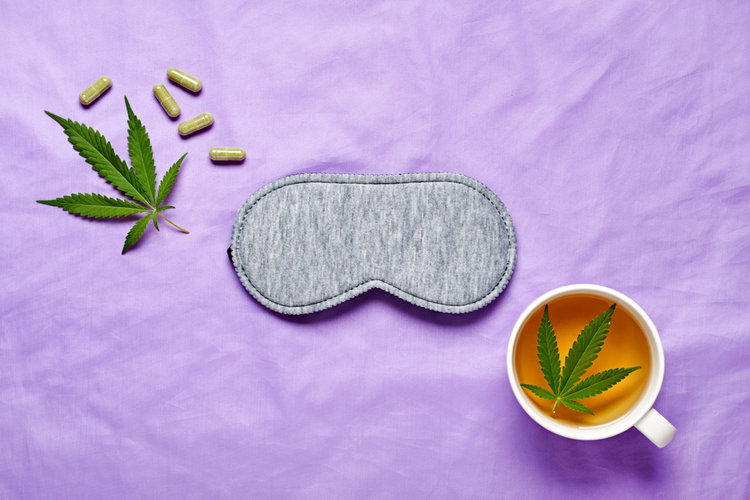
How does delta-9-THC affect sleep and dreams?
Delta-9-THC can shorten the amount of time you spend in REM sleep and typically intensifies the fourth stage of non-REM sleep. This interaction with the sleep cycle suppresses dreaming activity by prolonging the duration of the non-REM sleep phase.
It may help users feel more rested, but it can shorten the time remaining in the REM sleep phase, where most dreaming occurs, before the alarm clock rings in the morning. Delta-9-THC’s interference with the REM sleep phase could help people with post-traumatic stress disorder (PTSD) who experience nightmares triggered by traumatic past experiences. This works precisely because of delta-9-THC’s ability to suppress dreaming.
This cannabinoid may also be useful for people suffering from insomnia, as research suggests that it can induce and promote a deeper state of rest.
How does delta-8-THC affect dreaming?
An earlier study of the effects of various cannabinoids on seizures found that delta-8-THC has a similar effect on REM sleep as delta-9-THC. It can be assumed that, due to its similarity to delta-9, delta-8-THC also suppresses dreams.
The extent of this suppression has not been researched. One counterargument is that, given the mild sedative effects of delta-8-THC, total sleep time may be prolonged, allowing users to transition from non-REM sleep to REM stages earlier than planned awakening. This could (theoretically) lead to more time spent dreaming.

What about CBD and its effect on dreams?
CBD (cannabidiol) is a non-psychoactive cannabinoid that may have a different effect on REM sleep than THC. One study found that CBD effectively blocks anxiety-induced REM sleep suppression but has little effect on non-REM sleep. This could suggest that CBD increases the amount of time spent dreaming during the night. However, this effect has not been further officially investigated.
Unofficial reports from users suggest that people who take CBD before bed experience more vivid or lucid dreams (ones that can be controlled and consciously created). Some users have also reported that CBD significantly improves their ability to remember their dreams. However, there is little evidence as to why and how CBD improves dreaming and dream recall.
On the other hand, some people report that taking CBD before bedtime reduces dream activity. The effects of CBD on dreaming are likely to vary greatly from person to person. Some people dream more vividly, while others have fewer dreams after taking CBD.
Does CBG affect dreams too?
CBG (cannabigerol) is a less common cannabinoid than CBD and THC. However, it may help induce sleep and improve rest. CBG is growing in popularity, but as it is still a relatively new member of the cannabis community, there is little research on its effects on sleep.
Anecdotal evidence suggests that CBG may help with insomnia by promoting sleep and inducing a deeper state of rest without disrupting the REM phase of sleep. Some people claim that this cannabinoid actually helps induce sleep better than CBD and THC. However, everyone interested in this issue must form their own opinion, as there are few scientific studies.
Although there is little research on this cannabinoid so far, there is a lot of anecdotal evidence suggesting that it has potential as a sleep aid. We look forward to future studies on CBG that could potentially confirm these claims.
Do cannabinoids cause crazy dreams or suppress them?
It is commonly said that smoking cannabis before bed causes users to suppress their dreams, but is this true? Many people report that after smoking cannabis or using it regularly, they are unable to recall their dreams or do not dream at all.
Cannabis may potentially help people suffering from insomnia because it actually induces sleep. However, some studies suggest that the deep sleep that cannabis can induce may suppress dreams. A study that examined the effects of THC on REM sleep (the deep sleep phase when rest occurs) found that it can reduce REM sleep and shorten sleep latency.

REM sleep (rapid eye movement) is the stage during the sleep cycle when dreams occur.
This is when the brain is most active and creative. Suppressing and shortening this stage of sleep could mean that cannabis actually suppresses dreams. Vivid dreams and intense nightmares are common side effects of cannabis withdrawal. Although you may not experience increased dream activity after smoking cannabis, if you are a heavy user, you may experience a period of intense activity after quitting.
Regular cannabis use shortens the amount of time you spend in REM sleep while lengthening the amount of time you spend in stage 4 of the sleep cycle. This results in less dream activity.
Although suppressing REM sleep does not appear to have any long-term side effects, it can affect you after you stop using cannabis. You may experience a rebound effect, where your REM sleep activity increases and you spend more time in this stage. This can result in a significant increase in brain activity. Although it is not entirely clear why this occurs, it is a well-documented phenomenon.
A 2011 study looked at withdrawal symptoms in cannabis users and found that the most commonly reported problems were sleep disturbances, with nightmares and vivid dreams being the most common. So, while cannabis may actually dull your dreams when you use it, dream activity can increase dramatically when you stop using it. When THC is removed from the equation, other cannabinoids can promote dreaming activity.
Some users of popular cannabinoids such as CBD report having significantly more vivid or “crazy” dreams during sleep.
How can cannabinoids be used for relaxation?
Cannabis can be an excellent remedy for those who have trouble sleeping. People suffering from insomnia in particular can really benefit from cannabinoids such as delta-8-THC, CBD, and possibly CBG. These cannabinoids can induce sleep and help promote healthy nighttime rest.
For people suffering from post-traumatic stress disorder, it may be appropriate to use delta-8-THC, for example. This cannabinoid can potentially improve sleep quality and help suppress the REM phase of sleep, during which traumatic dreams and nightmares can occur.
On the other hand, people who want to achieve better dream recall and are looking for a way to improve the vividness of their dreams may want to try CBD. This cannabinoid can help improve the visual aspect of dreaming and help users recall their dreams more effectively. Different cannabinoids have different effects on the sleep cycle. Which cannabinoid is right for you depends on how you want to change your sleep cycle.
What happens during the different stages of sleep?
As you may already know, there are two main stages of sleep – rapid eye movement (REM) and non-rapid eye movement (non-REM). However, many people don’t know that non-REM sleep has several different stages. Each stage of non-REM sleep affects our rest. The amount of time you spend in each stage of sleep ultimately affects the quality of your sleep and how you enter REM sleep, which influences dream activity.
Certain cannabinoids can affect these different stages of sleep and alter the quality of your sleep and dreams. To understand how cannabis and its compounds affect sleep and dream activity, you must first understand the five stages of sleep in detail.
1. Non-REM sleep (first stage)
The first stage of sleep occurs when you first fall asleep. This stage is characterized by slow muscle movements and twitches and slow eye movements. Although you are technically unconscious, you are most aware during this stage of sleep. You can think of the first stage of non-REM as a period of light sleep. Because you are aware of external factors, sudden noises and other disturbances can wake you up during this stage.
2. Non-REM sleep (second stage)
The second stage of non-REM sleep occurs after you move from the first stage of light sleep into a deeper state of rest. During the second stage, you are unaware of your surroundings and are unlikely to be awakened by mild external disturbances. However, if you do wake up, you will feel completely awake. In this stage of sleep, your heart rate slows, your body temperature drops, and your eye movements slow or stop completely.
3. Non-REM sleep (third stage)
The third stage of non-REM sleep takes you into a deeper sleep. During this stage, your brain waves slow down and become less active. Your muscles relax and your breathing slows down. It is difficult to wake up from the third stage. Even louder external disturbances may not wake you up. If an external factor, such as an alarm clock, does wake you up, you will be disoriented, sleepy, and slow to move. As a result, you may feel more tired, fall back asleep, and oversleep.
4. Non-REM sleep (fourth stage)
The fourth stage of non-REM sleep is an even deeper stage of sleep. Brain waves continue to slow down and it is even more difficult to wake up from sleep. The fourth stage is known as the stage of sleep in which tissue repair occurs. It is also believed that hormones that promote growth are released during this stage.
5. REM sleep (stage 5)
The fifth and final stage of sleep is known as REM sleep and occurs approximately 90 minutes after entering stage 1. This is the stage of sleep during which dreaming occurs.
Your eyes move rapidly and your breathing begins to quicken, becoming shallower and faster than in the non-REM stages. During this stage, your blood pressure and heart rate increase again, and activity in the areas of the brain responsible for memory and learning also increases. It is believed that dreaming occurs during this stage of sleep, stimulating the parts of the brain responsible for storing and retrieving information.
Although brain waves increase along with blood pressure and heart rate, the arms and legs are virtually paralyzed. It is believed that this paralysis occurs so that we do not physically act out our dreams. It is this stage of sleep that can be disrupted by high levels of THC. Studies suggest that heavy cannabis users may experience fewer dream states because THC shortens the time the body remains in REM sleep.
Bottom line: do cannabinoids really cause crazy dreams?
Some cannabinoids may suppress dream activity, while others may promote more vivid dreams. Cannabis as a whole does not cause “crazy” dreams. Rather, it causes a weakening of REM sleep and, as a result, a suppression of dream activity.
However, the withdrawal phase when cannabinoid use is suddenly stopped can cause a period of intense dreaming. In addition, when certain cannabinoids are isolated and used individually, users may experience increased dream activity. If you want cannabis and its many cannabinoids to help you sleep or improve your dream recall, be sure to spend enough time researching, as the effects of different cannabinoids on the sleep cycle vary significantly.
Author: Elena Moreau
Photo: Shutterstock
“All information provided on this website, as well as information provided through this website, is for educational purposes only. None of the information provided here is intended to replace a medical diagnosis, and such information should not be considered medical advice or recommended treatment. This website does not endorse, approve, or advocate the legal or illegal use of narcotic or psychotropic substances or the commission of any other illegal activity. For more information, please see our Disclaimer.”
Imported from Canatura. Links have been converted to thcvapestores.com where possible.